

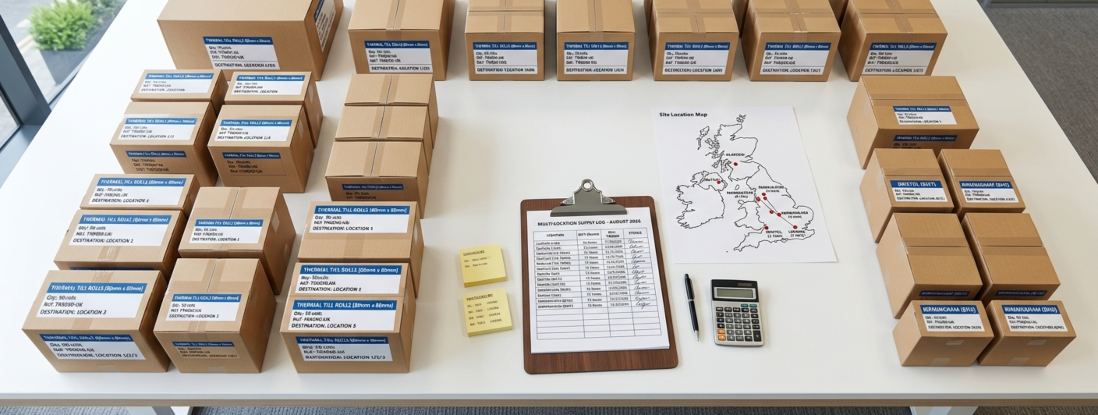
Managing a single business location comes with its own operational demands. Managing two, five, ten, or more locations simultaneously introduces an entirely different category of complexity — and one area where that complexity shows up more consistently than most operators expect is the supply of receipt paper and till rolls.
On the surface, till rolls seem like a simple consumable. Order them when you need them, store them somewhere sensible, use them until they run out. For a single site, that rough-and-ready approach works adequately, if not perfectly. For a multi-site business — whether a restaurant group, a retail chain, a franchise operation, or a national service company — it creates a fragmented, inconsistent, and often unnecessarily expensive supply situation that quietly costs the business time and money every week.
This guide is written for operations managers, procurement teams, and business owners responsible for managing till roll and receipt paper supply across multiple UK locations. It addresses the specific challenges that multi-site purchasing presents, the risks of leaving each location to manage its own supply independently, and the practical steps to building a centralised, reliable, cost-effective wholesale receipt paper strategy that works at any scale.
The Multi-Site Till Roll Problem: Why It Is Bigger Than It Looks
When each location in a multi-site business manages its own till roll purchasing independently, the result is almost always a patchwork of different suppliers, different product specifications, different quality levels, and wildly different unit costs. One manager orders from a local cash and carry. Another has a standing order with a generic online stationery retailer. A third orders from a marketplace seller who sometimes delivers on time and sometimes does not. A fourth simply grabs whatever is cheapest on the day.
The consequences of this decentralised approach accumulate steadily and mostly invisibly. Different suppliers mean different quality levels — one location has pristine receipts while another has faded, barely legible printout that customers and staff both find frustrating. Different specifications ordered independently mean occasional — or frequent — instances of the wrong roll arriving for the wrong machine. And without any consolidated purchasing, the business as a whole is paying single-unit retail prices across every site rather than the significantly lower per-roll cost available through wholesale volume ordering.
For a business with ten locations each spending £30 to £50 per month on till rolls at retail prices, that is £3,600 to £6,000 per year on a consumable that could cost materially less under a properly structured wholesale arrangement. The saving is real, repeatable, and requires no compromise on quality — in fact, a properly managed wholesale supply relationship typically delivers better quality and more consistency than the decentralised alternative.
The Risks of Decentralised Purchasing
Beyond the cost implications, decentralised till roll purchasing across multiple sites introduces several operational risks that are worth examining explicitly.
Inconsistent product quality. When individual site managers source rolls independently, there is no guarantee that the product arriving at each location meets the same dimensional or print quality standards. A machine that runs perfectly on a well-manufactured UK roll may jam repeatedly on a cheaper imported alternative with slightly inconsistent tolerances. Across a multi-site operation, this inconsistency becomes a persistent, distributed maintenance problem.
Stock-out risk at individual locations. Without centralised oversight of stock levels, individual locations are entirely responsible for monitoring their own supply and reordering in time. The busiest, most understaffed sites — often the ones most in need of reliable supply — are also the ones most likely to let stock run low and place emergency orders at the last minute, paying premium prices for express delivery in the process.
Specification drift. When site managers reorder independently, there is a meaningful risk of specification errors creeping in over time — particularly if a manager leaves and is replaced, if a card terminal provider is changed at one location, or if a new machine type is introduced without the specification being clearly communicated. A single incorrect order at one site creates an immediate operational problem. Specification drift across multiple sites creates a slow-burning one.
Administrative overhead. Managing multiple supplier relationships, multiple invoices, multiple delivery windows, and multiple product catalogues across several locations is a significant administrative burden — one that falls on either site-level staff who have other priorities, or central operations teams who are tracking too many variables to manage any single supplier relationship well.
Building a Centralised Receipt Paper Supply Strategy
The solution to all of the above is a centralised wholesale supply strategy — one supplier, one relationship, one agreed product specification per machine type, and one consolidated ordering and delivery arrangement that serves every site in the business from a single point of control.
The practical benefits of centralisation extend across every dimension of the problem. Cost comes down through consolidated volume. Quality becomes consistent because every site receives the same precision-manufactured product. Stock-out risk is managed centrally rather than left to individual site managers. Administrative overhead is dramatically reduced. And the business gains full visibility of its till roll consumption and expenditure across the entire estate.
Building this strategy effectively requires four things: a clear audit of what roll types and sizes each location currently uses, a decision on the correct specification going forward, a wholesale supplier capable of servicing the volume and delivery requirements of a multi-site operation, and a stock management framework that keeps every location adequately supplied without carrying excessive inventory.
Step One: Audit Your Roll Types Across All Locations
Before any consolidated purchasing can begin, you need a complete, accurate picture of what roll types and sizes are currently in use across every site. This means documenting, for each location, every device that uses a till roll — POS terminals, card machines, kitchen printers, cash registers — and the exact roll specification for each one: width in millimetres, diameter in millimetres, and core size in millimetres.
In practice, this audit often reveals that different sites are using subtly different specifications for what is notionally the same machine type — a consequence of different staff ordering slightly different products over time. The audit also frequently identifies opportunities for standardisation: where one site uses a 57mm x 40mm card machine roll and another uses a 57mm x 38mm, for example, it may be possible to standardise on a single specification that works correctly in both terminal models, simplifying the product range required across the estate.
Document the output of this audit in a simple reference document — one row per device type, with the confirmed roll specification, the relevant product from your chosen supplier, and the approximate consumption rate per week. This document becomes the foundation of your ongoing supply management.
Step Two: Standardise Specifications Wherever Possible
Standardisation is one of the most powerful levers available to a multi-site business managing consumables supply. Every time you can reduce the number of distinct roll specifications across your estate, you reduce purchasing complexity, reduce the risk of incorrect orders, and increase the volume at which you are ordering any single product — which in turn improves unit pricing.
Where all sites use the same card terminal model, standardising on a single card machine roll specification is straightforward. Where hospitality sites all use the same kitchen printer model, standardising kitchen printer roll specification is equally achievable. The goal is not to force a single roll to do a job it is not designed for — compatibility always takes priority — but to identify every genuine opportunity to consolidate the range.
For businesses operating a mix of retail and hospitality sites, or sites with different machine configurations, full standardisation may not be possible. In these cases, the objective is to reduce to the smallest practical number of distinct specifications, with a clear, documented mapping of which specification applies to which site and device type.
Step Three: Calculate Your Consolidated Volume Requirements
Once you have a clear picture of your roll specifications and consumption rates across all sites, the next step is to calculate your total consolidated volume requirement. This is the figure that unlocks wholesale pricing and determines the most efficient ordering structure for your business.
Aggregate the weekly consumption rate for each roll specification across all sites. Multiply by your preferred supply interval — whether that is monthly, bi-monthly, or quarterly — and factor in the buffer stock level you want to maintain at each location. The result is your total order quantity per specification per supply cycle.
For a business with ten sites each using two boxes of card machine rolls per week, that is twenty boxes per week or roughly 80 to 100 boxes per month across the estate. At that volume, the per-roll cost under a wholesale arrangement is meaningfully lower than single-box retail pricing — and the saving compounds across every roll specification in use.
Step Four: Choose a Wholesale Supplier Built for Multi-Site Operations
Not every till roll supplier is set up to serve multi-site businesses effectively. The requirements go beyond simply offering a bulk discount on large orders. A wholesale supplier capable of supporting a multi-site operation should be able to deliver to multiple UK addresses from a single order, maintain consistent stock across a broad range of specifications, provide dedicated account management for ongoing supply relationships, and offer the flexibility to adjust order quantities and delivery schedules as the business evolves.
The Wholesale page at Till Roll World outlines the full range of options available for multi-site and high-volume customers — from consolidated pallet deliveries to a central distribution point through to split deliveries directly to individual sites. Bespoke arrangements covering custom packaging, branded rolls, and account-managed reordering are also available for businesses with specific operational requirements.
The team can be reached directly on 0191 3232 326 or at orders@tillrollworld.co.uk to discuss your estate’s specific requirements and agree the most efficient supply structure for your volume and locations.
Managing Stock Levels Across Multiple Sites
Centralised purchasing does not have to mean centralised storage. Depending on the size of your estate and your logistics infrastructure, there are several practical models for getting the right stock to the right location at the right time.
Central warehouse distribution. For larger businesses with their own distribution capability, ordering in consolidated pallet quantities to a central warehouse and distributing to sites as part of existing internal logistics is the most cost-efficient model. It maximises the volume discount available from the supplier and gives the business complete control over site-level stock management.
Direct site delivery. For businesses without their own distribution infrastructure, arranging split deliveries direct from the supplier to each site — on a coordinated schedule — achieves the benefits of centralised purchasing without requiring internal logistics capability. Each site receives its allocated stock directly, reducing handling costs and keeping supply chain complexity minimal.
Hybrid model. Many multi-site businesses use a combination — bulk delivery of the most commonly used roll types to a central point, with direct site delivery for lower-volume or site-specific specifications. The right model depends on your estate size, site geography, and internal capability.
Whichever model you choose, the key is that stock levels at every site are monitored against the documented consumption rate and replenished before they reach the minimum threshold — not after. A simple shared stock tracking document or basic inventory management system is sufficient for most estates; the discipline of monitoring and acting on the data is what matters most.
The Complete Range for Multi-Site Operations
A wholesale receipt paper supplier serving multi-site businesses needs to cover every roll type and size those sites require — not just the most popular specifications. For a business operating a mix of retail, food service, and hospitality sites, that typically means thermal rolls in several sizes, card machine rolls for multiple terminal models, and kitchen printer rolls in both single-ply and multi-ply formats.
The THERMAL TILL ROLLS range covers over 70 size specifications for POS systems and cash registers, all UK-manufactured to precision tolerances. The CREDIT CARD ROLLS category covers more than 30 compact roll sizes for the full range of card payment terminals used across UK businesses. And the Kitchen Printer Rolls range covers the thermal and bond paper formats used in kitchen order printing systems across the UK hospitality sector.
Having access to the complete range from a single supplier — all available under one wholesale account, all eligible for next working day delivery on orders placed before 1:30pm — means a multi-site business can consolidate its entire receipt paper supply into one relationship and one reordering process, regardless of how varied the device types across its estate.
Why UK-Made Quality Matters at Multi-Site Scale
The quality argument for UK-manufactured rolls is compelling for a single-site business. For a multi-site operation, it becomes even more significant. When substandard imported rolls cause machine problems — jams, faded print, inconsistent feeding — those problems multiply across every site using the same stock. A quality issue that is a minor inconvenience at one location becomes a distributed operational problem across ten.
As a specialist Thermal Till Rolls | Cash Register Paper | PDQ & Receipt Paper Rolls UK supplier, Till Roll World manufactures its full range in the UK to consistent, precise specifications — the same quality standard in every box, every delivery, every site. For a multi-site business building a supply strategy designed to last, that baseline consistency is not a premium consideration. It is the foundation on which reliable supply at scale is built.
Final Thoughts
Receipt paper and till rolls are a small line item in the budget of any individual business site. Across a multi-site estate, they represent a supply management challenge that repays a structured, centralised approach with real cost savings, better quality consistency, reduced administrative overhead, and the elimination of stock-out risk at every location.
The investment required to build that approach is modest — an audit of current specifications, a consolidation of suppliers, and an agreed wholesale arrangement with a UK manufacturer capable of serving your estate at scale. The returns compound across every site, every week, for as long as the supply relationship remains in place.
To discuss your multi-site requirements and explore the most effective supply structure for your business, contact the Till Roll World team on 0191 3232 326 or email orders@tillrollworld.co.uk.
Frequently Asked Questions
Can Till Roll World deliver to multiple business locations from a single order?
Yes. Split deliveries to multiple UK sites can be arranged as part of a wholesale account. Whether you need delivery to two locations or twenty, the team can structure an arrangement that suits your estate’s geography and operational requirements.
What is the minimum order quantity for a wholesale multi-site account?
Till Roll World accommodates businesses at a range of volume levels, from multi-box orders through to full pallet supply. Contact the team directly to discuss the most cost-effective arrangement for your specific volume and number of sites.
How do we standardise till roll specifications across sites with different machine types?
Start with a full audit of every device type at every site, recording the exact roll specification — width, diameter, and core size — for each one. Where different sites use the same machine model, standardise immediately. Where machine types differ, document the correct specification per site and device type and order accordingly. The Till Roll World team can assist with compatibility checks across your estate if needed.
Can we get custom branded till rolls for our multi-site business?
Yes. Custom printed rolls — including branded receipts carrying your logo, promotional messaging, or contact details — are available as part of the wholesale offering. Contact the team to discuss specifications, minimum order quantities, and lead times for custom print runs.
How do we calculate how much stock each site should hold?
Track each site’s weekly consumption rate per roll type, then multiply by your preferred buffer period — typically two to four weeks. This gives the minimum stock level for each site. Reorder is triggered when any site reaches its minimum level, ensuring stock is replenished before it runs out.
Is it possible to manage all sites under a single invoice account?
Yes. A consolidated trade account allows all sites to be managed under a single billing relationship, with one invoice covering the entire estate regardless of delivery destinations. This significantly reduces the administrative overhead of managing till roll supply across multiple locations.
What roll types are available for hospitality businesses with kitchen printers?
Kitchen printer rolls in both thermal and 2 ply or 3 ply bond paper formats are available, covering the most common kitchen printer models used across UK restaurants, pubs, and food service operations. All are available for wholesale ordering alongside thermal POS and card machine rolls under the same account.
How does wholesale pricing compare to buying single boxes across all sites?
The saving varies by volume, but for a multi-site business consolidating purchasing that was previously done at retail single-box prices, a reduction in per-roll cost of 15 to 30 per cent or more is realistic at meaningful volumes. Over a full trading year across an estate of several sites, this represents a substantial and recurring cost saving on what is otherwise a commodity consumable.