

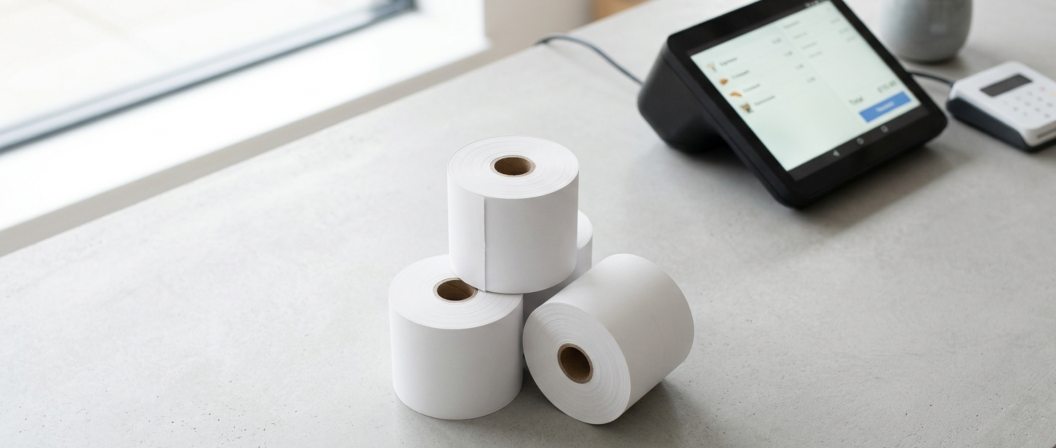
For any UK retailer, the point-of-sale system is the operational heartbeat of the business. Every transaction flows through it — card payments, cash sales, refunds, loyalty redemptions, VAT receipts. And at the centre of that process, quietly doing its job thousands of times a week, is the POS machine roll. A small cylinder of paper that most retailers only notice when it runs out, jams, or produces a receipt so faded the customer has to hold it up to the light to read it.
Choosing the right POS roll for your retail environment is not complicated once you understand the key variables — but getting it wrong creates a steady stream of minor frustrations that add up to real operational cost. The wrong size jams the machine. Poor thermal coating quality means faded receipts that reflect badly on the business. Inferior dimensional tolerances cause inconsistent feeding that slows down checkout and frustrates staff. None of these problems are difficult to solve. They all come down to using the right roll, sourced from the right supplier.
This guide covers everything UK retailers need to know about POS machine rolls — what they are, which sizes are most commonly used in retail environments, what to look for when choosing a product, and how to ensure your supply never lets you down during a busy trading period.
What Are POS Machine Rolls?
A POS machine roll is the receipt paper roll used in a point-of-sale terminal to print customer receipts at the checkout. In modern retail environments, POS rolls are almost universally thermal rolls — paper with a heat-sensitive coating that reacts to the printer’s heated print head to produce text, numbers, barcodes, and logos without any ink, ribbon, or toner.
This inkless printing process is what makes thermal POS rolls so well-suited to retail use. They print fast — critical during busy checkout queues — they produce consistently sharp output, they require no consumable replacement beyond the roll itself, and they operate reliably across a very wide range of temperature and humidity conditions typical of UK retail environments.
POS rolls are distinct from the compact rolls used in standalone card payment terminals. While both are thermal paper, a POS roll is typically wider and longer — designed to print a full itemised receipt listing every product purchased, with pricing, discounts, VAT breakdown, store information, and in many cases a returns policy or promotional message at the bottom. This fuller receipt content requires more paper per transaction, which is why POS rolls are sized accordingly.
The Most Common POS Roll Sizes for UK Retailers
POS roll size is determined by three measurements: width in millimetres, diameter of the full roll in millimetres, and core size — the diameter of the inner cardboard tube. All three must match your POS terminal’s specification for the roll to fit and feed correctly.
The most widely used POS roll widths in UK retail are 80mm and 57mm, with 80mm being the standard for most modern POS systems. Here is an overview of the most common specifications and their typical retail applications:
80mm x 80mm — The most common POS roll size in UK retail. Used across the broadest range of modern POS terminal models from manufacturers including Epson, Star Micronics, Bixolon, and many others. Suits medium to high-volume retail environments where receipts include full product listings, VAT breakdowns, and promotional content.
80mm x 70mm — A slightly shorter roll used in the same range of 80mm printers. Suitable for retail environments with moderate transaction volumes where a shorter roll life between changes is acceptable.
80mm x 60mm — A compact 80mm roll used in smaller POS terminal housings or environments with lower transaction frequency. Common in specialist retail, boutique stores, and smaller independent shops.
57mm x 57mm — Used in older or more compact POS systems, and in some cash register models where a narrower paper width is required. Also used in some hospitality front-of-house terminals where receipt content is more concise.
44mm rolls — Used in specialist cash registers and older retail equipment. Less common in modern retail but still required by a meaningful number of businesses operating legacy equipment.
If you are uncertain which size your POS system requires, check the existing roll in your machine — the specification is usually printed on the packaging or on a label on the roll core itself. Alternatively, your POS terminal’s user manual will specify the recommended paper width, diameter, and core size.
Thermal vs Other POS Roll Types: What Retailers Need to Know
The vast majority of modern retail POS systems use thermal printing, making thermal rolls the correct choice for almost every UK retailer operating current equipment. However, there are some scenarios where a different roll type may be relevant.
Older cash registers and legacy POS systems may use ink-based printing rather than thermal, requiring single ply bond paper rolls rather than thermally coated paper. These systems are increasingly rare in modern retail, but businesses operating older equipment should confirm their printer type before ordering thermal rolls — inserting thermal paper into an ink-based printer will produce blank receipts, as the printer has no mechanism to activate the thermal coating.
For retail businesses that also operate a separate card payment terminal alongside their main POS system, the card terminal will require its own compact roll — typically a 57mm or 58mm PDQ roll — which is a distinct product from the wider POS roll used in the main till. Both are thermal paper, but they are sized for completely different printer housings and should not be interchanged.
What to Look for in a POS Roll for Retail
Not all POS rolls are created equal. For a retail business processing dozens or hundreds of transactions daily, the quality of the roll has a direct impact on operational performance, customer experience, and the long-term condition of the POS printer.
Dimensional Precision
The single most important quality characteristic of any POS roll is dimensional accuracy — that the roll is precisely the correct width, diameter, and core size for the machine it is designed to fit. Even a fraction of a millimetre of deviation from the correct specification can cause the roll to sit unevenly in the printer housing, leading to skewed feeding, paper jams, and misaligned print.
UK-manufactured POS rolls are produced to tight, controlled tolerances that match the specifications used by POS terminal manufacturers in designing their machines. This precision is not incidental — it is the result of manufacturing processes that treat dimensional accuracy as a core quality requirement rather than an approximate target.
Thermal Coating Quality
The quality of the heat-sensitive coating on a thermal roll determines both the sharpness of the printed output and its longevity. A high-quality coating reacts consistently and precisely to the print head’s heat, producing sharp, well-defined text and barcodes from the first receipt to the last roll in every box. A poor-quality coating produces faded, patchy, or inconsistent output that deteriorates further with exposure to light, heat, and handling.
For retailers where customers frequently need to retain receipts — for returns, warranty claims, or expense purposes — receipt longevity matters. A thermal receipt from a quality-coated roll remains legible for significantly longer than one from a poorly coated alternative, reducing customer complaints and return disputes linked to unreadable proof of purchase.
BPA-Free Formulation
Thermal paper has historically used bisphenol A (BPA) as part of its coating chemistry. For retail staff who handle large numbers of receipts throughout the working day, BPA-free thermal paper is the responsible choice — and increasingly an expectation from environmentally and health-conscious retail employers. Till Roll World supplies BPA-free thermal rolls across its range, offering retailers a quality product without the associated staff welfare concerns of older BPA-containing formulations.
Roll Length and Change Frequency
Longer rolls contain more paper per change, which means less frequent roll changes during busy trading periods. For a high-volume retailer with queues at the checkout during peak hours, a 80mm x 80mm roll that lasts significantly longer than a 80mm x 60mm alternative reduces the frequency of service interruptions for roll changes. The right choice depends on your transaction volume — higher volume environments benefit most from longer rolls, while lower-volume or space-constrained terminal housings may be better suited to shorter formats.
POS Rolls Across Different Retail Environments
The specific POS roll requirements of a UK retailer depend in part on the type of retail environment and the nature of the transactions being processed.
Grocery and Convenience Retail
High transaction volumes and fast checkout speeds make 80mm rolls in longer formats — 80mm x 80mm being the standard — the natural choice for grocery and convenience retail. The priority is consistent, fast printing with minimal roll change interruptions during busy periods. BPA-free formulation is particularly relevant here, given the high frequency of receipt handling by checkout staff.
Clothing and Fashion Retail
Fashion retailers often print more detailed receipts — including product codes, size and colour information, return policy reminders, and promotional messaging — which reinforces the case for the wider 80mm format. The legibility and longevity of the receipt is important in this sector, as customers frequently retain receipts for returns or exchanges weeks after the original purchase.
Pharmacy and Health Retail
Pharmacies and health retailers may print receipts with longer item lists and more detailed product information, particularly for prescription dispensing receipts. The 80mm format handles this content comfortably, and in environments where receipt retention for reimbursement or record purposes is common, receipt longevity through quality thermal coating is a meaningful consideration.
Specialist and Independent Retail
Smaller independent retailers, boutiques, and specialist shops often use more compact POS terminals with 57mm paper requirements, or older cash register systems. For these businesses, the roll specification may be narrower but the quality requirements — dimensional precision, coating consistency, BPA-free formulation — remain exactly the same.
Managing POS Roll Supply for Retail Businesses
For a retail business processing transactions across every opening hour, running out of POS rolls is not a theoretical risk — it is a predictable operational event that should be managed proactively rather than reactively. The right supply strategy depends on your transaction volume, the number of tills you operate, and how frequently you want to reorder.
The THERMAL TILL ROLLS range covers the full spectrum of POS roll sizes used across UK retail — from compact 44mm specialist rolls through to the standard 80mm formats used in most modern checkout systems. All are UK-manufactured to precision tolerances, available in standard boxes of 20, and eligible for next working day delivery on orders placed before 1:30pm.
For retailers also operating card payment terminals alongside their main POS system, the CREDIT CARD ROLLS category covers the compact PDQ roll sizes required by the full range of UK card terminal brands — so both product types can be sourced from a single supplier under a single order.
Retailers with straightforward single-ply receipt printing requirements — whether on a POS system or a standalone receipt printer — will find the full range of options in the Single Ply Rolls category, which covers a wide selection of widths and lengths for both thermal and plain paper printing applications.
For retail chains and multi-site operations looking to consolidate their till roll purchasing across all locations, the Wholesale page outlines the full range of bulk and pallet ordering options — with account-managed arrangements available for businesses requiring consolidated invoicing, split deliveries to multiple sites, or bespoke packaging and branding on their rolls.
Why UK-Made POS Rolls Are the Right Choice for Retailers
The UK retail sector operates in a competitive, margin-sensitive environment where operational reliability and customer experience are both directly influenced by the quality of the consumables used at the point of sale. A till roll that jams during a busy Saturday afternoon costs more in staff time, queue disruption, and customer frustration than the few pence saved by choosing a cheaper product.
Imported POS rolls — many produced in China and other overseas markets to looser dimensional and coating quality standards — introduce a level of variability that well-managed retail operations simply do not need. Width inconsistencies cause jamming. Coating quality variations produce faded output. Core size deviations cause wobbling and skewed printing. These are not rare edge cases — they are predictable consequences of manufacturing processes that do not prioritise the same precision standards as UK production.
As a specialist Thermal Till Rolls | Cash Register Paper | PDQ & Receipt Paper Rolls UK supplier, Till Roll World manufactures its full range of POS rolls in the UK to precision-cut tolerances and controlled thermal coating quality — the same standard in every roll, every box, every delivery. For retailers who want their checkout to run smoothly every day without giving their till rolls a second thought, that consistency is what makes the difference.
Final Thoughts
The best POS machine roll for a UK retailer is the one that fits the machine precisely, prints sharply and consistently, holds up to customer handling and storage, and arrives reliably from a supplier whose quality standards do not vary between orders. These are not demanding requirements — but they are ones that not every supplier in the market consistently meets.
For retailers ready to source their POS rolls from a UK manufacturer they can depend on, the team at Till Roll World is available on 0191 3232 326 or at orders@tillrollworld.co.uk for compatibility guidance, bulk pricing enquiries, and any assistance needed to find the right roll for your specific checkout system.
Frequently Asked Questions
What size POS roll does my retail till use?
The most common POS roll size for modern UK retail is 80mm wide, with lengths of 60mm, 70mm, or 80mm depending on the terminal model. Check your existing roll packaging for the full specification — width, diameter, and core size in millimetres — or consult your POS terminal’s user manual for the manufacturer’s recommended paper specification.
Are POS rolls and till rolls the same thing?
The terms are often used interchangeably, but in practice a POS roll typically refers specifically to the wider thermal roll used in a point-of-sale terminal, while till roll is a broader term that encompasses all receipt paper types including compact card machine rolls, kitchen printer rolls, and multi-ply rolls. Most retailers use both POS rolls and card machine rolls across different devices.
Can I use any 80mm thermal roll in my POS printer?
Not necessarily. While the width must match, the diameter of the full roll and the core size must also be correct for the roll to fit the machine’s paper compartment and feed correctly. Always confirm all three dimensions — width, diameter, and core — before ordering to ensure full compatibility.
How long does a typical POS roll last in a retail environment?
It depends on transaction volume and the length of the roll. A busy grocery checkout processing several hundred transactions per day will typically get through a standard 80mm x 80mm roll in a day or two. A lower-volume boutique might use the same roll over several days or a week. Tracking your consumption rate helps you set an appropriate stock level and reorder schedule.
Why do my receipts sometimes print faded or patchy?
Faded or patchy thermal receipts are usually caused by one of three things: a poor-quality thermal coating on the roll itself, a print head that needs cleaning, or a print head that is reaching the end of its serviceable life. If fading appears across a new batch of rolls from a different supplier, the coating quality is the most likely cause — switching to a precision-manufactured UK roll often resolves the issue immediately.
Do POS rolls work in all POS terminal brands?
Thermal POS rolls are compatible with all thermal POS terminals, provided the dimensions match the machine’s specification. Till Roll World’s range covers the roll sizes used by all major POS terminal brands sold in the UK market, including Epson, Star Micronics, Bixolon, and many others.
What is the difference between BPA and BPA-free thermal rolls?
BPA (bisphenol A) is a chemical historically used in the thermal coating of receipt paper. Research into its potential health effects has led to growing demand for BPA-free alternatives, particularly in retail environments where staff handle large numbers of receipts daily. Till Roll World supplies BPA-free thermal rolls across its range, offering the same print performance without the associated health concerns.
How do I avoid running out of POS rolls during busy periods?
Set a minimum stock level based on your transaction volume — the point at which you reorder, not the point at which you run out. For most retail businesses, a two to four week buffer is appropriate. With next working day delivery available on orders placed before 1:30pm, maintaining that buffer through proactive reordering ensures your checkout is never without paper during peak trading.