

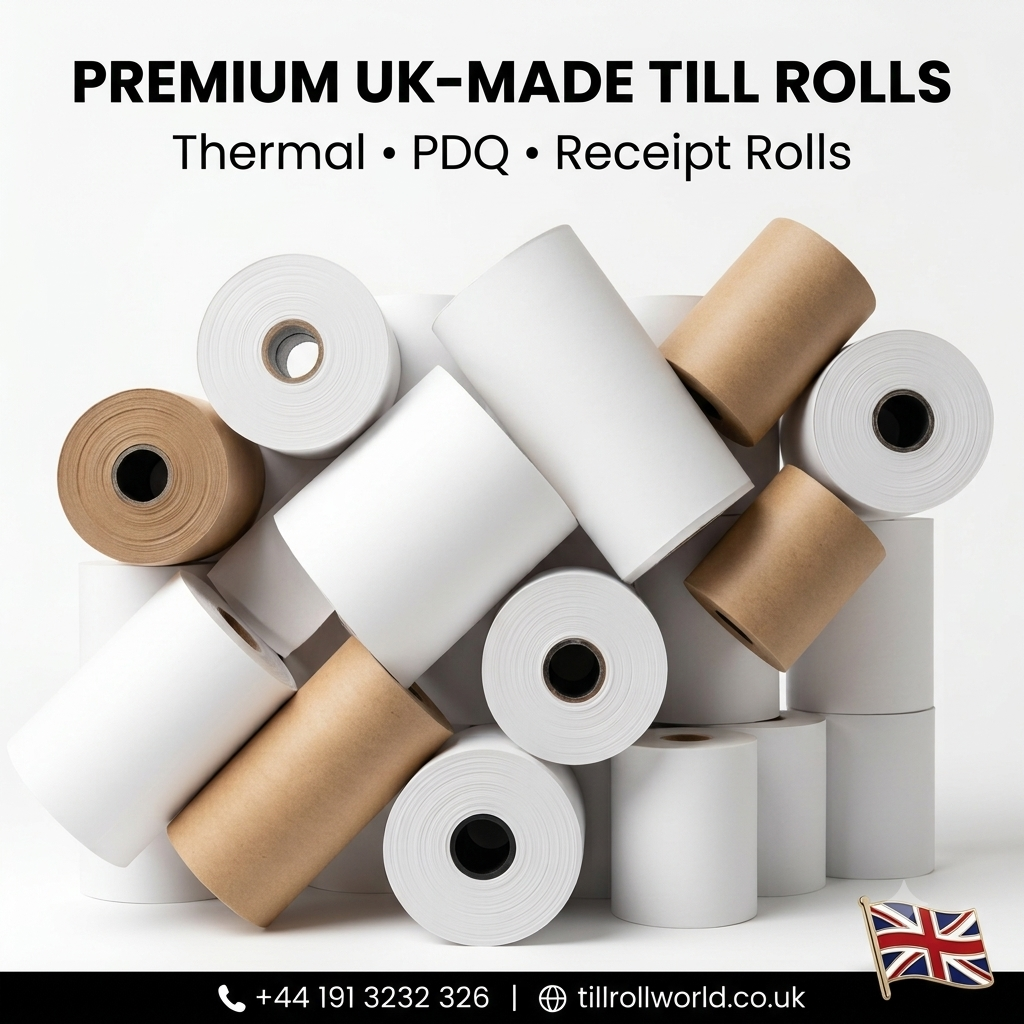
If you have ever typed “till roll prices UK” into a search engine and ended up more confused than when you started, you are not alone. The pricing of till rolls varies considerably depending on the type of paper, the size of the roll, the quantity ordered, and — critically — the quality of the product itself. For retail and hospitality businesses managing tight margins, understanding what drives till roll pricing helps you make smarter purchasing decisions, avoid overpaying for poor-quality stock, and build a supply strategy that genuinely supports your day-to-day operations.
This guide breaks down UK till roll pricing clearly and honestly — covering thermal rolls, credit card machine rolls, multi-ply rolls, and the significant difference between single-box and bulk pricing. We also address the hidden costs that come with opting for the cheapest products on the market, which often end up costing more in the long run than a quality UK-made alternative.
What Factors Affect Till Roll Pricing?
Till roll pricing is not one-size-fits-all. Several variables combine to determine what a business actually pays per roll, and understanding each one helps you evaluate whether a price you are seeing represents genuine value or a false economy.
Roll type. Thermal rolls, multi-ply rolls, and specialist bond paper rolls are priced differently because they involve different manufacturing processes and materials. Thermal rolls are the most competitively priced for everyday use. Multi-ply rolls cost more per unit because they involve multiple bonded paper layers with pressure-sensitive chemistry.
Roll size. Larger rolls — those with a greater diameter or length — contain more paper per roll and are priced accordingly. A compact 57mm x 30mm card machine roll contains far less paper than a 80mm x 80mm POS roll, and this is reflected in the unit price.
Paper quality and specification. Not all thermal paper is the same. Paper weight (measured in GSM — grams per square metre), coating quality, and dimensional precision all affect cost. Premium, BPA-free thermal paper manufactured to tight tolerances costs more to produce than budget-grade imports — but it also performs better, lasts longer, and causes fewer machine problems.
Order quantity. Price per roll drops significantly as order quantity increases. A single box of 20 rolls has a higher unit cost than a bulk pallet order. For businesses with predictable consumption, moving to larger orders is one of the most straightforward ways to reduce per-roll cost without compromising quality.
Country of manufacture. UK-manufactured till rolls carry a modest premium over cheaply imported alternatives — primarily because they are produced under stricter quality controls and to more precise dimensional standards. However, as we explore later in this guide, the true cost of cheap imports often exceeds that premium once you factor in machine maintenance, wasted stock, and poor print quality.
Thermal Till Roll Prices: What to Expect
Thermal rolls are the most widely used till roll type across UK retail and hospitality, and they represent the most competitive part of the market in terms of pricing. A standard box of 20 thermal rolls typically starts from around £4 to £6 for the most compact sizes, rising to £15 to £20 or more for larger POS rolls in the 80mm width range.
Here is a general pricing guide by size for UK-made thermal till rolls sold in standard boxes of 20:
- 57mm x 30mm (compact card machine rolls) — from approximately £4.20 per box of 20
- 57mm x 40mm (mid-length card machine rolls) — from approximately £5.45 per box of 20
- 57mm x 50mm — from approximately £7.99 per box of 20
- 80mm x 70mm (standard POS rolls) — from approximately £16.50 per box of 20
- 80mm x 80mm (larger POS rolls) — from approximately £16.65 per box of 20
- 44mm x 80mm (specialist cash register rolls) — from approximately £15.99 per box of 20
These prices reflect single-box quantities of premium, UK-manufactured thermal rolls. Bulk pricing across larger quantities brings the cost per roll down further — which we cover in detail in the bulk ordering section below.
To browse the full range with current pricing, the THERMAL TILL ROLLS category covers over 70 size specifications across retail, hospitality, and specialist machine applications.
Credit Card Machine Roll Prices: What Businesses Pay
Card machine rolls — also known as PDQ rolls — are among the most frequently purchased consumables for any business accepting card payments. Because card terminals print only a brief transaction confirmation rather than a full itemised receipt, these rolls are physically smaller than standard POS rolls, and their pricing reflects this.
The most common card machine roll sizes and approximate single-box prices for UK-manufactured rolls include:
- 57mm x 30mm — from approximately £4.20 per box of 20
- 57mm x 38mm — from approximately £4.80 per box of 20
- 57mm x 40mm — from approximately £5.45 per box of 20
- 57mm x 46mm — from approximately £6.60 per box of 20
- 57mm x 50mm — from approximately £7.99 per box of 20
Businesses running multiple card terminals — common in restaurants, bars, and retail stores with more than one checkout point — will work through card machine rolls at a significantly higher rate than single-terminal operations. For these businesses, the difference between single-box and bulk pricing can represent a meaningful saving over the course of a trading year.
Colour variants — pink, blue, yellow, and white — are also available across many card machine roll sizes, typically at a small premium over standard white rolls. These are used by businesses that colour-code receipts for operational or record-keeping purposes.
The CREDIT CARD ROLLS category lists all available sizes with current pricing, covering the full range of terminal brands and models used across UK businesses.
Multi-Ply Till Roll Prices
Multi-ply rolls — the 2 ply and 3 ply rolls used in impact dot matrix printers to create simultaneous duplicate or triplicate copies — are priced higher per unit than standard thermal rolls. This reflects the more complex manufacturing process: multiple paper layers must be precisely bonded with pressure-sensitive chemistry, and the layers themselves are typically colour-differentiated (white, pink, yellow) for operational clarity.
For the most commonly used kitchen printer formats, approximate pricing for UK-manufactured multi-ply rolls includes:
- 57mm x 57mm 2 ply (white/pink) — from approximately £8 to £10 per box of 20
- 76mm x 70mm 2 ply (white/pink) — from approximately £15.28 per box of 20
- 76mm x 70mm 3 ply (white/pink/yellow) — from approximately £18.95 per box of 20
The higher unit cost of multi-ply rolls is justified by the functional value they provide — two or three copies of every order or receipt produced simultaneously, which is operationally essential for kitchen printer environments in restaurants, pubs, and food service businesses.
The full Multi Ply range covers both 2 ply and 3 ply options across the standard sizes used in UK kitchen and trade printer systems.
Single Box vs Bulk Pricing: The Real Cost Difference
The single most effective way to reduce your per-roll cost without switching products is to increase your order quantity. The relationship between volume and price is significant in the till roll market, and businesses that calculate their annual consumption and order accordingly consistently pay less than those who reorder reactively in single boxes.
At single-box quantities, you are paying the standard retail price per roll. As you move into multi-box, pallet, and wholesale volumes, the per-roll price drops — and at full pallet quantities, the saving over a 12-month period can be substantial for a business with regular, predictable consumption.
Consider a business running three card terminals, each burning through one box of 20 rolls per week. That is 60 rolls per week, roughly 3,000 rolls per year. At standard single-box pricing for a 57mm x 40mm roll, the annual cost at approximately 27p per roll would be around £810. At wholesale volume pricing, even a 15 to 20 per cent reduction in unit cost represents a saving of £120 to £160 per year on that one roll type alone — and most businesses use more than one roll type.
For businesses ready to move to wholesale volumes, the Wholesale page outlines the full range of options available — from multi-box orders through to full pallet supply — with bespoke arrangements also available for trade resellers, cash and carry operators, and businesses with specific volume or packaging requirements.
The Hidden Costs of Cheap Till Rolls
Any honest pricing guide for UK till rolls has to address the cheaper end of the market — specifically the large volume of low-cost imported rolls, many manufactured in China and other overseas markets, that are available at prices that seem attractive on the surface.
At first glance, a box of 20 rolls at £2.50 versus £5.45 for a UK-manufactured equivalent looks like a significant saving. In practice, the actual cost of using inferior rolls is rarely reflected in the purchase price alone.
Paper jams and machine downtime. Cheap rolls are often manufactured to looser dimensional tolerances. Even a fraction of a millimetre of inconsistency in roll width or core size is enough to cause repeated jamming in a precision card terminal or POS printer. Every jam costs staff time, slows customer service, and — over time — causes wear on the printer’s feed mechanism that leads to costly repairs or early machine replacement.
Faded or unreadable receipts. Budget thermal paper often uses a thinner or lower-quality heat-sensitive coating. The result is receipts that print faintly, fade quickly under light or heat exposure, or produce incomplete text. For businesses where receipt legibility matters — returns, warranties, expense claims, VAT records — this creates a real operational problem.
Wasted stock. Rolls that darken in storage due to poor coating stability, or that arrive with dimensional defects that prevent them from loading correctly, are simply wasted money — regardless of how cheap they were to purchase.
Printer wear and repair costs. The cumulative effect of repeatedly feeding substandard rolls through a thermal printer is accelerated wear on the print head, feed rollers, and paper guide mechanisms. Thermal print heads are not inexpensive to replace, and the cost of a single repair can easily exceed the apparent saving made over months of buying cheap rolls.
UK-manufactured till rolls are produced to tight, consistent specifications — the kind that card terminal and POS manufacturers design their machines to receive. They feed cleanly, print sharply, and do not cause the downstream problems that make cheap rolls a false economy for any business that values operational reliability.
Getting the Best Value: A Practical Pricing Strategy
For retail and hospitality businesses looking to manage their till roll costs intelligently, a few straightforward principles make a consistent difference.
Know your exact specification before ordering. Ordering the wrong size — even by a few millimetres — means wasted stock and a reorder. Confirm width, diameter, and core size for every printer you operate before placing any order.
Calculate your annual consumption. Track how many boxes you use per month per device. Multiply by twelve to get your annual volume per roll type. This figure gives you the basis for evaluating bulk pricing against your current spend.
Order to a schedule, not a crisis. Reactive ordering — buying rolls only when you run out — almost always means paying single-box prices and potentially paying a premium for express delivery. Setting a minimum stock level and reordering when you reach it means you can always order at your most cost-effective quantity.
Consolidate your supply. If your business uses multiple roll types — thermal POS rolls, card machine rolls, and kitchen printer rolls — ordering everything from a single trusted UK supplier simplifies administration, reduces delivery costs, and gives you a consistent quality baseline across all devices.
As a specialist Till Roll Supplier, Till Roll World works with businesses at every scale — from independent retailers ordering single boxes through to multi-site hospitality groups and trade resellers placing pallet orders — with competitive pricing at every volume and expert guidance on finding the right roll for every machine.
Final Thoughts
Till roll pricing in the UK is straightforward once you understand what drives it — roll type, size, quantity, and quality. The lowest price per roll is rarely the best value when the hidden costs of poor-quality stock are taken into account. The smartest approach is to identify your exact specification, understand your consumption volume, and order at the quantity that gives you the best per-roll cost from a supplier whose manufacturing standards you can rely on.
For pricing enquiries, volume orders, or help identifying the correct roll for your machine, contact the Till Roll World team on 0191 3232 326 or email orders@tillrollworld.co.uk. All orders placed before 1:30pm qualify for guaranteed next working day delivery across the UK.
Frequently Asked Questions
How much does a box of till rolls cost in the UK?
Prices vary by type and size. Standard boxes of 20 UK-manufactured thermal rolls start from around £4 to £6 for compact card machine sizes, rising to £15 to £20 for larger POS rolls. Multi-ply rolls for kitchen printers typically range from £8 to £19 per box of 20 depending on the format.
Why are some till rolls so much cheaper than others?
Cheaper rolls are typically manufactured overseas to looser quality standards, using lower-grade thermal coating and less precise dimensional tolerances. The lower purchase price often comes at the cost of print quality, machine reliability, and roll longevity — making them a false economy for businesses that value consistent performance.
Do till roll prices include VAT?
Till rolls are subject to VAT at the standard UK rate of 20%. Always confirm whether prices shown are inclusive or exclusive of VAT when comparing suppliers, as this can significantly affect the real cost comparison.
Is it cheaper to buy till rolls in bulk?
Yes, meaningfully so. Per-roll cost drops significantly as order quantity increases. Businesses with predictable consumption — whether in retail, hospitality, or trade — can achieve notable annual savings by moving from single-box to multi-box or pallet-level ordering.
Are coloured till rolls more expensive than white?
Coloured thermal rolls — pink, blue, and yellow variants — are typically available at a small premium over standard white rolls. The price difference is modest, and colour-coded rolls provide operational value in environments where differentiating copies or receipts by colour is useful.
How do I work out my annual till roll spend?
Track how many boxes you use per month per device, multiply by the number of devices, then multiply by twelve. This gives you your annual consumption volume per roll type, which you can then use to request bulk pricing and calculate potential savings against your current single-box spend.
Do till roll prices vary by industry?
The product pricing is the same regardless of industry — what varies is the consumption rate and therefore the volume ordering strategy. A high-volume restaurant processing hundreds of covers per day will consume rolls far faster than a single-terminal trade business, making bulk ordering proportionally more valuable for higher-throughput environments.
Can I get a price quote for a large or ongoing till roll order?
Yes. Till Roll World provides pricing for bulk and wholesale orders, including pallet quantities and bespoke arrangements for trade resellers and multi-site businesses. Contact the team on 0191 3232 326 or by email at orders@tillrollworld.co.uk to discuss your requirements and receive a tailored quote.