

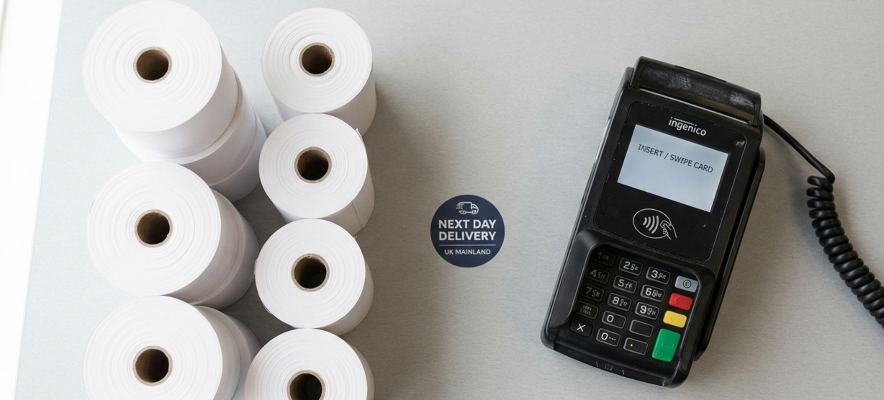
Picture the scene: it is a Saturday morning, your busiest trading day of the week, and your card machine runs out of paper ten minutes after opening. The roll you thought was the spare turns out to be the wrong size. Your online order from earlier in the week has not arrived. Your next customer is waiting. It is a scenario that plays out in retail shops, restaurants, and trade businesses across the UK every week — entirely avoidable, yet remarkably common.
The supply of till rolls is one of those operational details that business owners rarely think about until it fails. At that point, the consequences range from a minor inconvenience to a genuine disruption to trading — and in some cases, an inability to process card payments at all. For a business that depends on smooth, uninterrupted point-of-sale performance every single day, the reliability of your till roll supply is not a secondary consideration. It is a core part of how your operation functions.
This guide explores why reliable supply matters, what next day delivery actually means in practice, how to use it strategically rather than reactively, and how the right supplier relationship turns till rolls from a recurring problem into something you never have to think about at all.
The Real Cost of Running Out of Till Rolls
Running out of till rolls is easy to dismiss as a minor nuisance — a small operational hiccup that gets resolved in a few minutes. The reality is more consequential than it first appears, and the true cost depends on exactly when it happens and how your business handles card payment processing.
For Retail Businesses
A retail checkout that cannot print receipts creates an immediate friction point with customers. Some will accept a verbal confirmation of their transaction. Others — particularly those making higher-value purchases, buying items they may want to return, or those who need receipts for expense or VAT purposes — will not. The inability to provide a receipt reflects poorly on the professionalism of the business, and in some cases can lead to customers abandoning a purchase rather than completing it without documentation.
Depending on your card terminal configuration, some machines will also refuse to complete a transaction when the paper roll is empty, recognising that a receipt must be generated for compliance purposes. In these situations, running out of till rolls does not just mean no receipt — it means no sale.
For Hospitality Businesses
A restaurant or café that cannot print kitchen order tickets faces a different but equally disruptive problem. Without kitchen printer rolls, orders cannot be communicated to the kitchen in the structured, accurate way that busy service depends on. Staff resort to handwritten notes, verbal relay, or improvised systems — all of which are slower, more error-prone, and harder to manage during a full service. The result is delayed orders, increased mistakes, and a customer experience that falls below the standard the business works hard to maintain.
Similarly, a bar or restaurant that cannot print customer bills or payment receipts slows down table turnaround and creates unnecessary friction at the point of payment — the final impression a customer takes away from their visit.
For Trade and Mobile Businesses
For tradespeople and field service businesses using mobile card readers — plumbers, electricians, delivery drivers, market traders — running out of card machine rolls mid-job is a particular problem. There is no stockroom to raid, no nearby supplier to visit. A customer who wants a physical receipt for their payment cannot receive one, which can create doubt about the transaction, complicate record-keeping, and in some cases delay payment until proper documentation can be provided.
In all three contexts, the common thread is the same: a small consumable item, costing just a few pence per transaction to provide, creates a disproportionately large operational problem when it runs out at the wrong moment.
What Next Day Delivery Actually Means — and What to Look For
The phrase “next day delivery” appears on a significant number of till roll supplier websites. What it means in practice varies considerably, and the details matter when your business depends on a delivery arriving before you open the following morning.
Order cutoff time. Next day delivery is only genuinely useful if the cutoff time is late enough to accommodate a working business day. A supplier with a 10am cutoff provides limited value for a business that only notices low stock during the afternoon rush. A cutoff of 1:30pm — the standard at Till Roll World — gives businesses the flexibility to reorder at any point during a normal working morning and still receive delivery the following day.
Geographical coverage. Next day delivery UK-wide is meaningfully different from next day delivery for certain postcodes or mainland England only. Businesses in Scotland, Northern Ireland, the Channel Islands, or more rural locations should confirm explicitly that their postcode is covered by the next day guarantee before relying on it.
Carrier reliability. The supplier’s delivery promise is only as good as the carrier they use to fulfil it. A quality supplier with established carrier relationships and consistent fulfilment processes will have a reliable track record of meeting their delivery commitments. Vague claims about fast delivery, without a specific guarantee or stated carrier, are worth treating with caution.
Order tracking. The ability to track your delivery in real time — knowing when it has been dispatched, where it currently is, and what time window it is expected — allows your business to plan around the delivery and react immediately if anything goes wrong, rather than simply waiting and hoping.
Weekend and holiday considerations. Next working day delivery means exactly that — working day. Orders placed on a Friday afternoon will typically arrive on Monday. Orders placed before key bank holidays need to account for the reduced delivery schedule during that period. Understanding this in advance prevents the situation where you expect a Saturday delivery and receive one on Tuesday instead.
Using Next Day Delivery Strategically, Not Reactively
The most common mistake businesses make with till roll supply is treating next day delivery as a crisis solution rather than a planning tool. Ordering rolls only when you have run out — or are on the very last roll — puts your business in a vulnerable position every single time. If a delivery is delayed for any reason, or if you ordered the wrong product, there is no buffer between you and an empty machine.
A smarter approach is to use next day delivery as the foundation of a proactive stock management system rather than a last resort. This means establishing a minimum stock level for each till roll type your business uses — the point at which you reorder, not the point at which you run out — and treating that level as a non-negotiable operational threshold.
For a business using a single card terminal and running through one box of 20 rolls per week, a minimum stock level of two boxes gives a two-week buffer. When the second-to-last box is opened, a new order is placed. The delivery arrives the following day, the buffer is replenished, and the machine is never empty. For a business running multiple devices or processing higher transaction volumes, the same principle applies at proportionally higher stock levels.
This approach also means that next day delivery is no longer a premium, last-minute service that you are grateful for in a moment of crisis. It is simply the normal, efficient way your supply chain works — reliable, predictable, and entirely within your control.
Building a Reliable Till Roll Supply Strategy
For businesses that want to move beyond reactive reordering entirely, a structured supply strategy makes the management of till roll stock genuinely effortless. The elements of an effective strategy are straightforward.
Know your specifications exactly. Every till roll type your business uses should be documented — width, diameter, and core size in millimetres, along with the specific product name or code from your supplier. This documentation means that reordering is fast and accurate, and that any member of staff can place the correct order without needing to measure rolls or compare specifications.
Calculate your consumption rate. Track how many rolls each device uses per week. This tells you exactly how long any given quantity of stock will last and allows you to set accurate minimum reorder levels. It also gives you the data to evaluate whether bulk or wholesale ordering would reduce your per-roll cost meaningfully.
Set a reorder trigger. Establish a fixed point at which stock is reordered — not when it runs out, but when it reaches a defined minimum. For most businesses, a two to four week buffer is appropriate. For higher-volume or multi-site operations, a larger buffer may be warranted.
Use a single supplier for all roll types. Managing supply across multiple suppliers — one for thermal rolls, another for card machine rolls, a third for kitchen printer rolls — creates unnecessary complexity and multiple points of failure. A single, reliable supplier that covers all your till roll requirements simplifies reordering, reduces administration, and gives you one consistent quality standard across every device in your operation.
For businesses ready to move to bulk supply, the Wholesale page at Till Roll World covers the full range of ordering options from multi-box quantities through to full pallet supply — with bespoke arrangements available for businesses with specific volume, site, or packaging requirements.
The Full Range: Every Roll Type, One Reliable Supplier
For next day delivery to be a genuinely useful part of your supply strategy, your supplier needs to stock everything your business uses. A supplier with gaps in their range forces you to manage multiple supply relationships, which defeats much of the purpose.
The THERMAL TILL ROLLS range covers over 70 size specifications for POS systems, cash registers, and a wide range of specialist retail and hospitality machines — all UK-manufactured, all available for next working day delivery.
The CREDIT CARD ROLLS category covers more than 30 compact roll sizes matched to the full range of card payment terminals used across UK businesses, from Ingenico and Worldpay through to Dojo, Paymentsense, Barclaycard, and Verifone models.
For hospitality businesses running kitchen order printers, the Kitchen Printer Rolls range covers the thermal and bond paper formats used in the most common UK kitchen printer systems — in both 2 ply and 3 ply configurations for businesses that need simultaneous duplicate or triplicate order copies.
Having all three product types available from a single supplier, all eligible for next working day delivery on orders placed before 1:30pm, means your entire till roll supply chain — regardless of how many devices you operate or how many different roll types you use — can be managed through one relationship, one account, and one reorder process.
Why UK-Made Quality and Fast Delivery Go Together
Next day delivery is only genuinely valuable if the product you receive is the right one, fits correctly, and performs as expected from the first roll to the last. A delivery that arrives on time but contains substandard rolls that jam, print faintly, or simply do not match the machine’s specifications is not a supply success — it is a different version of the same problem.
UK-manufactured till rolls, produced to tight dimensional tolerances with controlled thermal coating quality, eliminate the uncertainty that comes with cheaper imported alternatives. When you order a 57mm x 40mm roll from Till Roll World, that is precisely what you receive — consistently, across every box in every order, every time. There is no variation in width, no inconsistency in core size, no lottery of whether the thermal coating will perform correctly from roll to roll.
For a business that has built next day delivery into its supply strategy, that consistency is the final piece of the puzzle. Reliable delivery of a reliably consistent product means your till roll supply is genuinely something you can set up once, manage with minimal effort, and depend on completely — which is exactly where your attention to this particular operational detail should end up.
As a specialist Thermal Till Rolls | Cash Register Paper | PDQ & Receipt Paper Rolls UK supplier, Till Roll World combines UK manufacturing quality with next working day delivery across the UK — serving businesses of every size from independent retailers and food traders through to national chains and wholesale trade customers. For orders or supply enquiries, call the team on 0191 3232 326 or email orders@tillrollworld.co.uk.
Final Thoughts
The supply of till rolls is a small operational detail with disproportionately large consequences when it goes wrong. Next day delivery, used strategically rather than reactively, turns that potential vulnerability into a reliable, low-effort part of how your business operates. Pair it with a UK-manufactured product you can depend on, a single supplier who stocks everything you need, and a sensible minimum stock level — and till rolls become something you genuinely never have to worry about again.
Frequently Asked Questions
Does Till Roll World offer guaranteed next day delivery?
Yes. All orders placed before 1:30pm qualify for guaranteed next working day delivery across the UK. Orders placed after the cutoff are dispatched the following working day for delivery the day after.
What happens if my next day delivery does not arrive on time?
Contact the Till Roll World team immediately on 0191 3232 326. The support team can investigate with the carrier, provide tracking information, and arrange resolution. This is why maintaining a minimum stock buffer — rather than ordering only when empty — protects your business from the rare occasion when a delivery is delayed.
Can I get next day delivery on bulk or wholesale orders?
Yes, next working day delivery is available on bulk orders placed before 1:30pm. For very large pallet orders, delivery timescales are confirmed at the point of order, and the team can advise on the most efficient fulfilment arrangement for your volume.
How do I set up a reorder reminder so I never run out of till rolls?
The simplest approach is to set a calendar reminder or stock management trigger at your defined minimum stock level — typically when you open the second-to-last box. When that trigger fires, place your reorder immediately. With next day delivery, the replacement stock arrives before the last box runs out.
Can I order multiple different till roll types in a single next day delivery?
Yes. Orders combining thermal rolls, card machine rolls, kitchen printer rolls, and multi-ply rolls are all fulfilled in a single delivery, provided the order is placed before the 1:30pm cutoff.
Is next day delivery available across all UK locations?
Next working day delivery is available UK-wide. If you are in a more remote location or have a specific postcode query, contact the team to confirm coverage and delivery timescales for your area before placing a time-sensitive order.
How much stock should my business hold to avoid running out?
For most businesses, a two to four week buffer is appropriate — enough to absorb a busy period or a minor delivery delay without any operational impact. Higher-volume or multi-site businesses may benefit from a larger buffer, particularly if they are ordering at wholesale or pallet quantities less frequently.
What is the best way to manage till roll supply across multiple business sites?
Consolidate purchasing through a single wholesale account with a supplier that can deliver to multiple UK addresses. This standardises the product across all sites, simplifies reordering and invoicing, and allows you to achieve better per-roll pricing through combined volume — all with the same next working day delivery guarantee at every location.